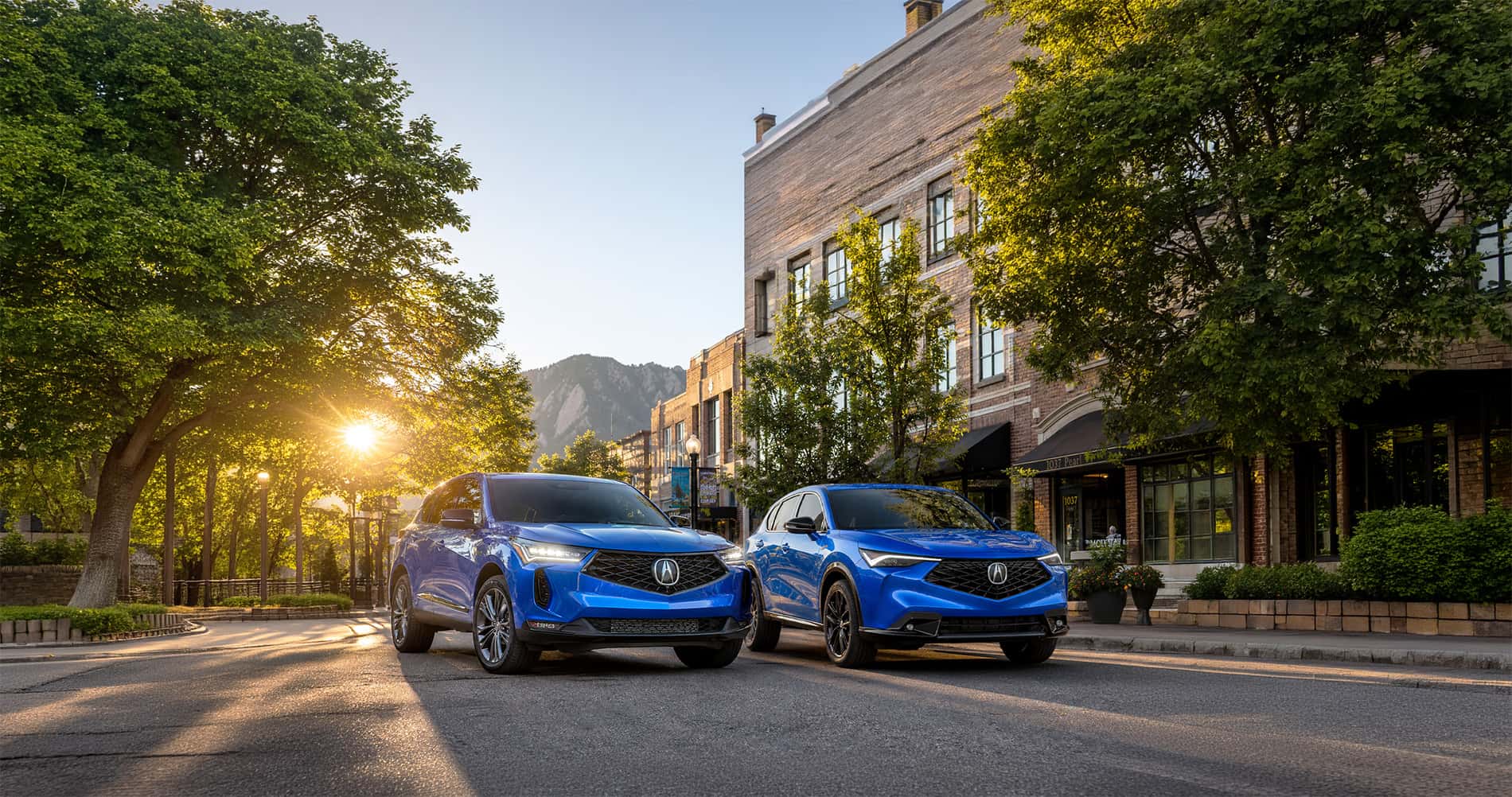
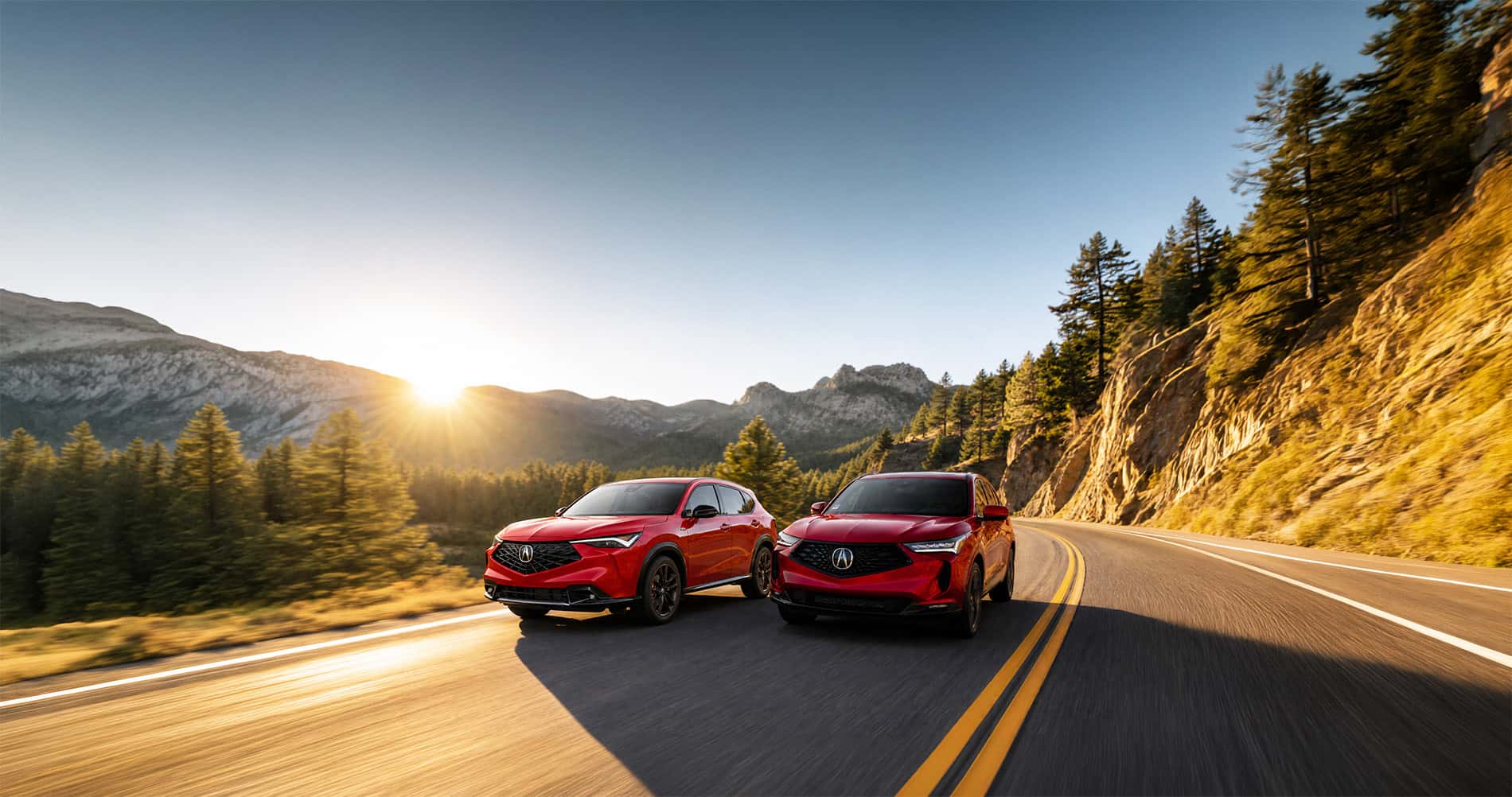
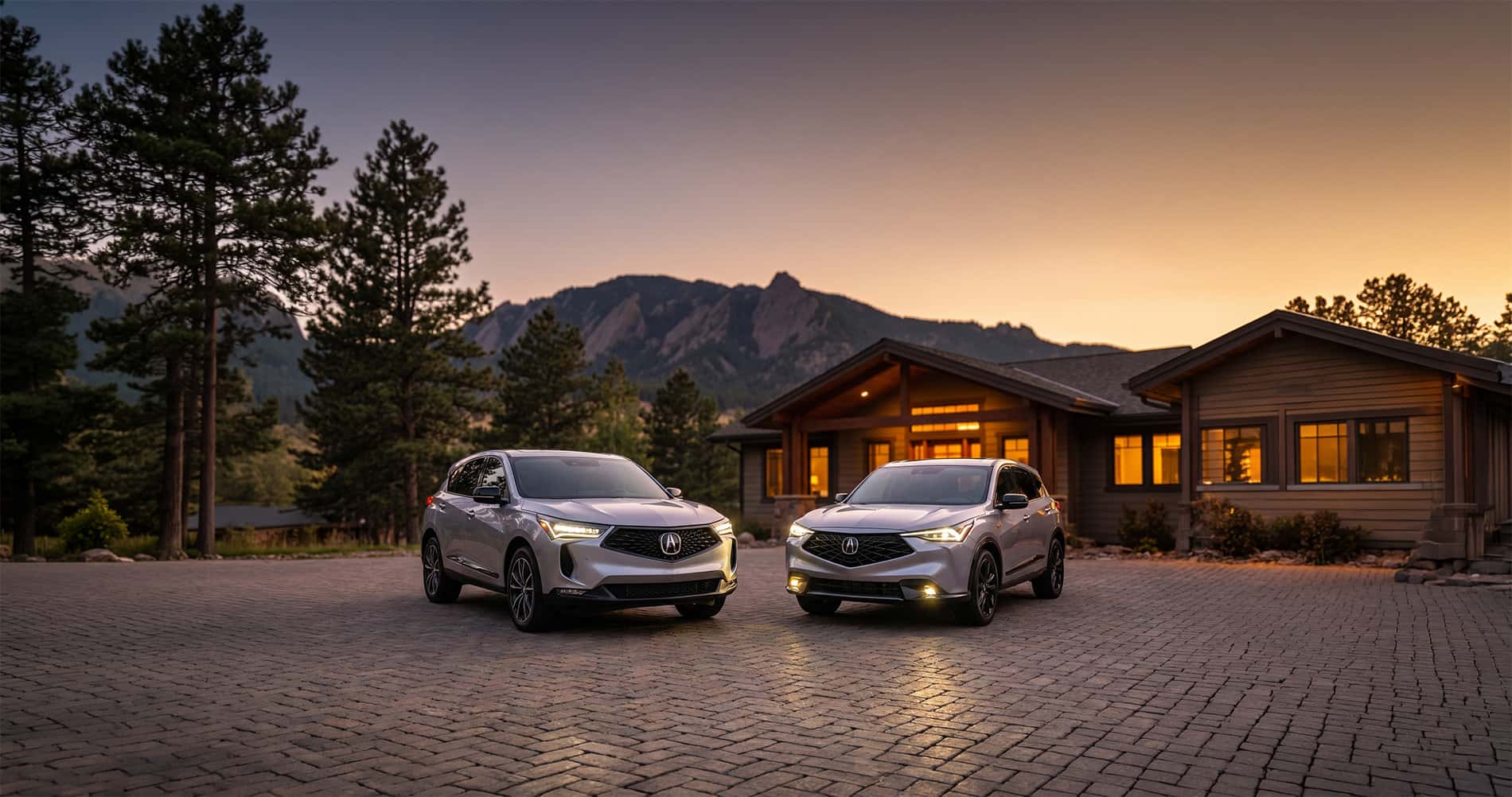
The 2026 Acura ADX vs 2026 Acura RDX comparison is less about which Acura SUV is “better” and more about which one fits the way you drive. Both models bring premium Acura design, five-passenger seating, turbocharged performance, modern technology, and available or standard all-wheel-drive confidence. The difference is that they solve different ownership needs.
The 2026 Acura ADX is the smaller and more efficient choice. It gives shoppers a lower starting MSRP, easier parking, strong feature availability, and the flexibility to choose front-wheel drive or available AWD. That makes it a smart fit for drivers who want Acura refinement without moving into a larger SUV than they need.
The 2026 Acura RDX is the stronger, roomier, and more performance-focused SUV. It costs more, but it also includes standard Super Handling All-Wheel Drive, a more powerful 2.0-liter turbocharged engine, greater passenger volume, more cargo space, and towing capability. For shoppers who regularly drive between Boulder, Broomfield, Louisville, Longmont, Denver, and the foothills, those advantages can matter in everyday ownership.
This comparison covers the key differences between the Acura ADX and Acura RDX, including trims and pricing, technology, performance, fuel economy, driving feel, exterior and interior dimensions, cargo space, safety features, and which SUV makes more sense for different types of Front Range drivers.
You want the more affordable Acura SUV, better fuel economy, easier maneuverability, available AWD, and a premium cabin that still feels well-equipped for commuting, errands, and everyday Boulder-area driving.
You want stronger acceleration, standard SH-AWD, more passenger space, more cargo room, towing capability, and a more confident SUV for winter weather, highway travel, and longer drives with people or gear.
| Question | Quick Answer |
|---|---|
| Which Acura SUV costs less? | The 2026 Acura ADX starts lower, with a starting MSRP of $35,000 compared with $45,100 for the 2026 Acura RDX.* |
| Which one is more fuel efficient? | The ADX is more efficient, with EPA ratings up to 26 city / 31 highway / 28 combined MPG* with FWD. The RDX is rated up to 21 city / 27 highway / 23 combined MPG* depending on trim. |
| Which one has more power? | The RDX has the clear performance advantage with 272 horsepower and 280 lb-ft of torque. The ADX has 190 horsepower and 179 lb-ft of torque. |
| Does the ADX have AWD? | Yes. The ADX comes standard with front-wheel drive and offers available all-wheel drive across the lineup. |
| Does the RDX have standard AWD? | Yes. Every 2026 Acura RDX comes standard with Super Handling All-Wheel Drive. |
| Which one has more cargo space? | The RDX offers more cargo room, especially when Acura’s underfloor-storage-inclusive cargo measurement is considered. |
| Which one is easier to park? | The ADX is narrower, shorter, and built around easier daily maneuverability. |
| Which one is better for Colorado winter driving? | The RDX has the advantage because SH-AWD is standard. The ADX can still be a strong winter-weather choice when equipped with available AWD and appropriate tires. |
Quick takeaway: The ADX is the cleaner fit for shoppers who value price, efficiency, and easier sizing. The RDX is the better match for drivers who want more power, more room, and standard AWD confidence.
The sections below compare the ADX and RDX by pricing, technology, performance, fuel economy, dimensions, cargo space, safety features, and real-world buyer fit.
The fastest way to understand the Acura ADX vs RDX comparison is to think about how each SUV fits into daily life. The ADX is the easier Acura SUV to justify if you want premium features, efficient commuting, simpler parking, and enough space for a two-row routine without moving into a larger vehicle.
The RDX is built for shoppers who want more vehicle beneath them. Its extra power, standard SH-AWD, larger cabin, and towing rating make it better suited to drivers who frequently carry passengers, travel with gear, deal with winter conditions, or want a more confident feel on longer highway drives.
| Category | 2026 Acura ADX | 2026 Acura RDX |
|---|---|---|
| Highlighted differences only — not a complete list of all features, specifications, or options. | ||
| Vehicle Role | Premium compact SUV | Premium sport crossover |
| Starting MSRP* | $35,000 | $45,100 |
| Engine | 1.5L turbocharged inline-4 | 2.0L turbocharged inline-4 |
| Horsepower / Torque | 190 hp / 179 lb-ft | 272 hp / 280 lb-ft |
| Drivetrain | • FWD standard • AWD available |
SH-AWD standard |
| EPA MPG* | • 26 city / 31 highway / 28 combined FWD • 25 city / 30 highway / 27 combined AWD |
• 21 city / 27 highway / 23 combined on most trims • 21 city / 26 highway / 23 combined on A-Spec trims |
| Passenger Volume | Up to 97.3 cu. ft. | 104.0 cu. ft. |
| Max Cargo Volume | Up to 55.1 cu. ft. | Up to 79.8 cu. ft. with underfloor storage measurement |
| Towing Capacity* | Acura does not publish a tow rating in the reviewed 2026 ADX specifications | 1,500 lbs |
Quick takeaway: The ADX is the more practical choice for shoppers who want Acura style and technology in a smaller, more efficient SUV. The RDX is the better fit when the SUV needs to feel stronger, roomier, and more prepared for varied Colorado driving.
The ADX lineup is straightforward, which helps shoppers focus on how much comfort and technology they want rather than sorting through a long package list. Its lower starting point is useful for buyers who want to stay in the Acura family while prioritizing monthly budget, fuel costs, and easy day-to-day ownership.
The RDX asks for more investment, but it also changes the baseline. Shoppers are not just paying for a higher trim name; they are stepping into a more powerful SUV with standard SH-AWD, a larger cabin, and a more performance-oriented platform. That makes the RDX easier to justify when AWD, stronger acceleration, and added space are already must-haves.
| Trim / Package | 2026 Acura ADX Starting MSRP* | 2026 Acura RDX Starting MSRP* |
|---|---|---|
| MSRP shown before taxes, title, license, registration, destination, options, premium colors, and dealer pricing differences. | ||
| Base Model | $35,000 | $45,100 |
| Technology-Oriented Step | Not a separate ADX package | Technology Package: $47,700 |
| A-Spec | A-Spec: $38,200 | A-Spec: $50,700 |
| Advance-Oriented Step | A-Spec with Advance: $42,400 | Advance Package: $52,850 |
| A-Spec + Advance | A-Spec with Advance: $42,400 | A-Spec Advance Package: $54,850 |
| Drivetrain Context | • FWD standard • AWD available across ADX trims |
SH-AWD standard across all RDX trims |
Pricing takeaway: The ADX is the easier starting point for Acura SUV shoppers. The RDX becomes the stronger value argument when its standard AWD, added power, and larger interior are features the buyer would have chosen anyway.
The ADX does a good job giving shoppers the modern Acura experience without requiring a larger SUV. Its technology story is strongest for drivers who want an easy daily interface, wireless phone integration, helpful charging access, and available connected features in a cabin that still feels compact and manageable.
The RDX technology advantage is less about one single feature and more about how the cabin feels over time. The larger display setup, available premium audio, available head-up display, and higher-level comfort features make a bigger difference during long commutes, weekend trips, and drives where passengers spend more time in the vehicle.
For a driver who mainly wants a clean, current, well-equipped Acura, the ADX covers the important ground. For a household using the SUV as the main vehicle, the RDX offers more of the comfort and convenience depth that tends to matter after the first few months of ownership.
| Feature Category | 2026 Acura ADX | 2026 Acura RDX |
|---|---|---|
| Displays | • 10.2-inch digital instrument cluster • 9-inch color touchscreen |
• 7-inch color multi-information display • 10.2-inch HD dual-content center display |
| Smartphone & Charging | • Wireless Apple CarPlay compatibility • Wireless Android Auto compatibility • Wireless phone charger |
• Wireless Apple CarPlay compatibility • Wireless Android Auto compatibility • Wireless charging pad |
| Audio | • Acura Premium Sound System with 8 speakers • Bang & Olufsen 15-speaker system on A-Spec with Advance |
• Acura Premium Audio System with 9 speakers • ELS Studio 12-speaker system on Technology • ELS Studio 3D 16-speaker system on A-Spec, Advance, and A-Spec Advance |
| Comfort Upgrades | • Heated front seats standard • Ventilated front seats on A-Spec • Heated steering wheel on A-Spec with Advance |
• Heated front seats standard • Ventilated front seats on Advance and A-Spec Advance • Heated rear outboard seats on A-Spec Advance |
| Premium Tech | • Google built-in on A-Spec with Advance • Alexa Built-in on A-Spec with Advance |
• Acura Navigation standard across packages • Alexa Built-In • Head-up display on Advance and A-Spec Advance |
Technology takeaway: The ADX delivers the right features for connected daily driving. The RDX feels more premium when comfort, audio, visibility, and passenger experience are part of the ownership decision.
The ADX is tuned for drivers who want smooth, efficient, low-stress driving rather than maximum acceleration. That works well for commuting along US 36, running errands around Boulder County, or using the SUV as a refined daily vehicle where fuel economy and easy maneuvering matter more than extra output.
The RDX feels more confident when the drive asks for more. Its stronger engine and standard SH-AWD are useful when merging onto faster highways, climbing toward foothill communities, passing with passengers onboard, or driving through mixed winter conditions. It is the more satisfying Acura SUV for shoppers who care about response and control as much as utility.
The fuel economy tradeoff is real. The ADX is the better match for drivers who want to keep operating costs lower, while the RDX gives up efficiency in exchange for the kind of power and traction that can make the vehicle feel more settled across a wider range of driving situations.
| Performance Category | 2026 Acura ADX | 2026 Acura RDX |
|---|---|---|
| Engine | 1.5L DOHC turbocharged VTEC inline-4 | 2.0L 16-valve DOHC VTEC turbocharged inline-4 |
| Horsepower | 190 hp @ 6,000 rpm | 272 hp @ 6,500 rpm |
| Torque | 179 lb-ft @ 1,700-5,000 rpm | 280 lb-ft @ 1,600-4,500 rpm |
| Transmission | CVT with paddle shifters | 10-speed automatic with Sequential SportShift paddle shifters |
| Drivetrain | • FWD standard • AWD with Intelligent Control System available |
Super Handling All-Wheel Drive standard |
| EPA MPG — FWD* | 26 city / 31 highway / 28 combined | Not available; RDX is SH-AWD only |
| EPA MPG — AWD / SH-AWD* | 25 city / 30 highway / 27 combined | • 21 city / 27 highway / 23 combined on RDX, Technology, and Advance • 21 city / 26 highway / 23 combined on A-Spec and A-Spec Advance |
| Towing Capacity* | Acura does not publish a tow rating in the reviewed 2026 ADX specifications | 1,500 lbs |
Performance takeaway: The ADX is the better fit for efficiency-minded Acura shoppers. The RDX is the stronger choice when passing power, all-weather traction, and a more confident driving feel matter more than fuel savings.
The ADX makes sense for shoppers who want an SUV but do not want the vehicle to feel oversized for daily life. Its smaller footprint helps with garages, parking lots, downtown streets, and quick errands, while still giving buyers the raised seating position and flexible cargo area that make small SUVs so useful.
The RDX is better for households that regularly use the second row or cargo area. The extra width and passenger volume are noticeable when adults ride in back, when child seats are part of the routine, or when the cargo area is expected to handle travel bags, outdoor gear, groceries, pet supplies, or weekend equipment.
This is one of the most important parts of the comparison because size affects every drive. The ADX will feel simpler and more efficient to manage. The RDX gives shoppers more room before the vehicle starts feeling crowded, which can make it the better long-term fit for drivers whose needs may change.
| Measurement | 2026 Acura ADX | 2026 Acura RDX |
|---|---|---|
| Length | 185.8 in. | 187.4 in. |
| Width | 72.5 in. | 74.8 in. |
| Wheelbase | 104.5 in. | 108.3 in. |
| Ground Clearance — Unladen | 7.3 in. | 8.2 in. |
| Passenger Volume | • 97.3 cu. ft. on ADX • 96.0 cu. ft. on A-Spec and A-Spec with Advance |
104.0 cu. ft. |
| Legroom — Front / Rear | 41.9 / 37.7 in. | 42.0 / 38.0 in. |
| Shoulder Room — Front / Rear | 56.6 / 55.2 in. | 60.0 / 57.0 in. |
| Cargo Behind Second Row | • 24.4 cu. ft. on ADX and A-Spec • 23.2 cu. ft. on A-Spec with Advance |
29.5 cu. ft. / 31.1 cu. ft. with underfloor storage measurement |
| Maximum Cargo Volume | • 55.1 cu. ft. on ADX and A-Spec • 53.9 cu. ft. on A-Spec with Advance |
58.9 cu. ft. / 79.8 cu. ft. with underfloor storage measurement |
Size takeaway: The ADX is easier to park, maneuver, and fuel. The RDX is better when second-row comfort and cargo flexibility are part of the weekly routine.
The ADX and RDX both give shoppers a strong AcuraWatch foundation, so this section is not about one model feeling under-equipped. In normal commuting, lane support, adaptive cruise assistance, blind spot information, and cross-traffic support can all help reduce fatigue and make busy traffic feel more manageable.
The ADX is especially appealing because it brings meaningful driver-assistance coverage into Acura’s smaller SUV. That gives commuters and first-time Acura SUV shoppers a strong safety and convenience baseline without requiring them to move into the RDX.
The RDX adds its advantage through a more premium support path on higher packages. Features such as broader camera visibility and parking support can matter more on a larger vehicle, especially in tight garages, crowded lots, school drop-offs, or downtown spaces where visibility and low-speed confidence are part of daily use.
| Safety / Driver Assistance Feature | 2026 Acura ADX | 2026 Acura RDX |
|---|---|---|
| Core AcuraWatch Features | • Collision Mitigation Braking System • Road Departure Mitigation • Lane Keeping Assist • Adaptive Cruise Control with Low-Speed Follow |
• Collision Mitigation Braking System • Road Departure Mitigation • Lane Keeping Assist • Adaptive Cruise Control with Low-Speed Follow |
| Blind Spot / Cross Traffic Support | • Blind Spot Information System • Cross Traffic Monitor |
• Blind Spot Information System • Cross Traffic Monitor |
| Traffic Support | • Traffic Sign Recognition • Traffic Jam Assist |
• Traffic Sign Recognition • Traffic Jam Assist not listed in reviewed 2026 RDX specs |
| Parking / Low-Speed Support | • Low-Speed Braking Control on A-Spec with Advance • Front and rear parking sensors on A-Spec with Advance |
• Low-Speed Autonomous Emergency Braking available beyond base RDX • Front and rear parking sensors available beyond base RDX |
| Camera Support | • Rearview camera standard • Multiview camera system on A-Spec with Advance |
• Multi-view rear camera standard • Surround-view camera system on Advance and A-Spec Advance |
Safety takeaway: Both SUVs provide strong everyday driver assistance. The ADX is impressive for its size and price point, while the RDX adds more visibility and parking confidence as trims move higher.
The ADX is the better fit if your priorities are efficiency, easier parking, a lower starting price, and a premium cabin that still feels current and well-equipped. It is a smart choice for drivers who want Acura ownership without paying for extra size or performance they may rarely use.
The RDX is the better fit if your SUV needs to serve more roles. It is more appropriate for drivers who regularly carry passengers, travel with cargo, want stronger highway response, or prefer the confidence of standard SH-AWD for changing Colorado weather.
The outside review context supports that split. The ADX is praised for ride comfort and precise handling, but its personality is not built around maximum acceleration. The RDX leans more into Acura’s sport-crossover character, with stronger performance and a richer feature set for drivers who want a more engaging SUV.
• You want the lower starting MSRP
• You prefer a smaller Acura SUV
• Fuel economy matters more than horsepower
• You want available AWD without moving into RDX pricing
• You need premium features more than maximum space
• You want standard SH-AWD
• You prefer stronger acceleration
• You carry passengers or gear often
• You want towing capability
• You want the more athletic Acura SUV feel
Decision takeaway: The ADX is the cleaner fit for efficient premium ownership. The RDX is the better long-term match when space, power, and all-weather confidence are part of how the SUV will actually be used.
If you are comparing the Acura ADX vs RDX, Fisher Acura can help you look at both SUVs side by side and decide which one better fits your commute, parking needs, passenger space, cargo use, AWD expectations, and long-term ownership plans.
The 2026 Acura ADX and 2026 Acura RDX both bring Acura refinement into a practical two-row SUV format, but they serve different kinds of drivers. The ADX is the cleaner fit for shoppers who want premium design, useful technology, and available AWD without moving into more size, power, or cost than their routine requires.
The RDX is the better match when the SUV needs to carry more responsibility. Its stronger performance, standard SH-AWD, larger cabin, and added cargo flexibility give it more range for family use, changing weather, longer drives, and weekends that involve more people or gear.
For Fisher Acura shoppers around Boulder County and the Denver-Boulder corridor, the decision should come down to usage rather than status. Choose the ADX if you want the more efficient and manageable Acura SUV. Choose the RDX if you want the Acura SUV that feels more prepared for varied Colorado driving over the long term.
The main difference is size, strength, and purpose. The Acura ADX is the smaller and more efficient SUV, making it easier to park, easier to fuel, and easier to fit into a daily routine. The Acura RDX is larger, more powerful, and comes standard with SH-AWD, so it is better suited to shoppers who want more space, stronger response, and added confidence for changing road conditions.
Yes. The 2026 Acura ADX starts at $35,000 MSRP*, while the 2026 Acura RDX starts at $45,100 MSRP*. The ADX is the more accessible way into a new Acura SUV, while the RDX justifies its higher starting point with standard SH-AWD, more power, and a larger cabin.
The 2026 Acura RDX has more horsepower. Its 272-horsepower turbocharged engine gives it a stronger feel when merging, passing, climbing grades, or driving with passengers and cargo. The 190-horsepower ADX is better matched to efficient commuting and lighter daily use.
Yes. The 2026 Acura ADX comes standard with front-wheel drive and offers available all-wheel drive across the lineup. That gives shoppers more flexibility: choose FWD for the best efficiency, or add AWD for more confidence in rain, snow, and winter driving.
Yes. Every 2026 Acura RDX comes standard with Super Handling All-Wheel Drive. That is one of the biggest reasons to choose the RDX if all-weather traction, cornering confidence, and Colorado winter driving are major priorities.
The 2026 Acura ADX is more fuel efficient. It is the better fit for drivers who spend more time commuting, running errands, or driving locally and want to keep fuel use lower. The RDX gives up some efficiency in exchange for more power, standard SH-AWD, and a larger body.
The Acura RDX has more cargo space. That matters if you regularly carry luggage, outdoor gear, pet supplies, sports equipment, or larger grocery runs. The ADX still provides useful two-row SUV flexibility, but the RDX is the better fit when cargo room is part of the weekly routine.
Acura does not publish a towing capacity in the reviewed 2026 ADX specifications used for this article. If light towing is part of the purchase decision, the RDX is the safer comparison point because Acura lists it with a 1,500-pound towing capacity when properly equipped.
The better choice depends on the type of Colorado driving you do most. The ADX works well for efficient daily use around Boulder County, especially when equipped with AWD. The RDX is the stronger fit for drivers who want standard SH-AWD, more highway passing power, more space for gear, and added confidence for winter weather or foothills driving.
Choose the Acura ADX if you want the smaller, more efficient, more affordable Acura SUV. Choose the Acura RDX if you want stronger performance, more room, standard SH-AWD, and a more capable feel for longer drives, passengers, cargo, and changing weather.
The ADX is usually the better commuter choice if fuel economy, parking ease, and lower ownership cost matter most. The RDX is better for commuters who spend more time on faster highways, want stronger passing response, or prefer standard SH-AWD for year-round confidence.
Fisher Acura in Boulder can help shoppers compare the Acura ADX and Acura RDX side by side. The team can walk through pricing, trim differences, AWD needs, cargo space, technology, driving feel, and which SUV fits your daily routine around Boulder, Broomfield, Louisville, Longmont, Denver, and the surrounding Front Range.
Choosing between the 2026 Acura ADX and 2026 Acura RDX is easier when you can compare them around the way you actually drive. Fisher Acura can help shoppers look beyond the spec sheet and evaluate the differences that matter in daily ownership: parking ease, fuel economy, AWD needs, second-row space, cargo flexibility, highway confidence, technology preferences, and long-term fit.
For many Boulder-area drivers, the ADX will make sense as the more efficient and manageable Acura SUV. For others, the RDX will be the better match because it brings standard SH-AWD, stronger acceleration, added cabin room, and more cargo versatility. Visiting Fisher Acura gives you the chance to sit in both, compare visibility and storage in person, and decide which SUV feels better from the driver’s seat.
Fisher Acura serves drivers from Boulder, Denver, Broomfield, Louisville, Superior, Longmont, Erie, Lafayette, and the surrounding Front Range with a practical, no-pressure approach to comparing Acura SUVs.
DISCLAIMERS:
*MSRP does not include destination and handling fees, taxes, title, license, or dealer-installed options. Actual dealer price may vary.
*EPA-estimated fuel economy ratings. Actual mileage will vary depending on driving conditions, vehicle maintenance, driving habits, weather, and other factors.
*All-wheel drive availability varies by trim level and configuration. See dealer for details.
*Google Built-In requires compatible services and includes a limited-time data plan. Features, functionality, and availability may vary. Data plan and connected services may require a subscription after trial period ends.